
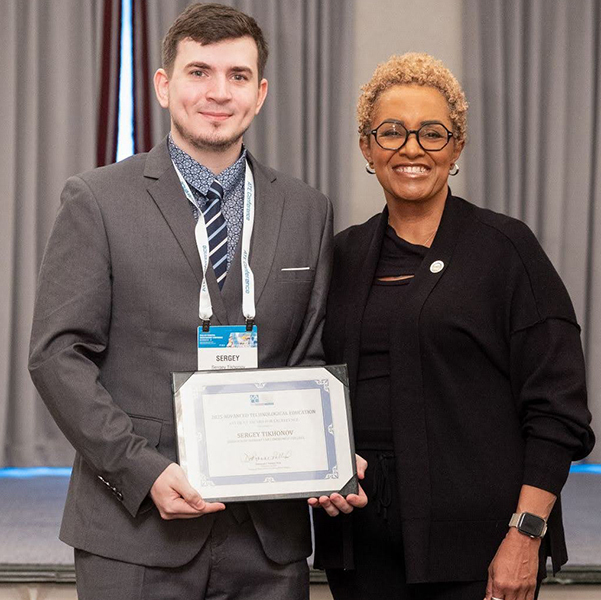
Each July, Disability Pride Month is observed in the US to celebrate disability identity and community. The CUNY School of Professional Studies (CUNY SPS), which is known for our groundbreaking online disability studies programs, is proud to commemorate this month by spotlighting an award-winning student project advancing research on neurodivergence in children. Sergey Tikhonov (BS in Information Science) developed the project, "Autism and Emotional Intelligence: The Promise of Web-based Software Interventions," as an interactive web application that helps children with autism recognize and manage emotions through engaging games and a parent dashboard that tracks learning progress. In recognition of his innovative research, Tikhonov received an Award for Excellence at the 2025 Advanced Technological Education Conference in Washington, DC. In the Q&A below, Tikhonov discusses the project, his studies at CUNY SPS, and what’s next after he earns his degree.
Q: Please tell us about the conference you attended and the award you received.
A: Initially, [we showed] our project at the Advanced Technological Education Conference, which was sponsored by the National Science Foundation (NSF)…There were a lot of different people, around 800 participants, and fifty-two of them were students from different community colleges from across the US. But then our project was specially recognized! At the time, I represented BMCC since they invited me, and they basically covered everything, even though now I'm a student at CUNY SPS. [Editor’s note: Tikhonov graduated from BMCC in December 2024].
Q: The project you presented at the DC conference used AI to help kids with autism spectrum disorder, right?
A: Not exactly…it was a website. The main reason why I chose a website is because it's free. Everybody who has access to the internet can access this website. The website mainly has assessment quizzes. The kid takes a quiz [about emotional responses], and you're going to see the results right away. We have a lot of different metrics on each emotion to look at how a kid did on each emotion. So, there are six core emotions, and then those emotions each have three sub-emotions. So, these core emotions are joyful, mad, peaceful, powerful, sad, and scared, with the sub-emotions there’s a total of eighteen. Now the analytics and algorithms can correlate, for example, sub-emotions. Is the kid maybe lacking some skills in one type of emotion or in the whole emotion itself? Is there a pattern? And overall, [parents can] check the progress. For example, if [the child] is taking a longer time on some emotion, that may be concerning. We want kids to learn how to recognize emotions quickly.
Q: Can you give an example of the type of quiz questions that you ask to identify this?
A: Okay, so there are three levels of difficulty there; I'll give you [an example of] level one:
- “Today my mom took me to the playground and bought me my favorite ice cream. I felt very happy.” True or false?
Q: It sounds like parents and teachers identify problem areas where they need to focus and work through that particular emotion that perhaps a child cannot properly identify, and then, modulate accordingly?
A: Yes, exactly.
Q: How did you get interested in neurodivergence?
A: To be honest, my interest started with self-reflection—I often wondered about my own thought processes and how I fit into the spectrum of neurodiversity. That personal curiosity grew into a broader fascination with how different minds work. I'm really intrigued by the cognitive side of it: how people process information differently, or the mechanics behind emotional regulation and shifting from one emotional state to another. Since my ultimate goal is to become a professor, understanding these connections is vital. I strongly believe that emotional intelligence and diverse ways of thinking are deeply tied to how students experience the educational system, and I want to be equipped to support that.
Q: What was the biggest challenge you faced as you worked on this project?
A: I would say probably the content. It was just very difficult to find those questions for the quiz. At first, I was trying to use LLMs (large language models) to generate the questions. But in the end, it just didn’t work. [So I had to] go through a bunch of questions, and then redo them, which took even longer. Then I was reading some studies and trying to write the questions myself. It was the biggest challenge, because it was something that I'd never done before. While creating web applications, creating the websites was something I do all the time. I've already done the web development courses. But writing the questions was very difficult.
And the second biggest challenge was probably the best way to approach the educational [aspect], since quizzes don’t really teach. Quizzes are something that is like an assessment tool. But then how is this going to help? I always overthink things… but how do I make sure that everything that is shown on the website is useful?
Q: What was the most interesting or unexpected thing that you learned from the project?
A: I didn't know there were so many emotions. I didn't know there is so much to it. I thought that all of emotions are just, you know, happy, sad, bored—that's it. Maybe angry. But there are so many of them, like a spectrum, and then when you go into a combination of emotions. Then how we go from one emotion into another. It’s a whole process of this. I would say [the most interesting thing I learned] was about emotions… Human existence overall, that is very interesting for me.
Q: What made you choose CUNY SPS?
A: My brother studied at CUNY SPS; he finished his Master's in Data Science here. So, he encouraged me to study here—mainly because I can work full-time, and at the same time, I can spend my evenings doing my homework and studying.
Q: What classes at CUNY SPS have particularly piqued your interest or challenged you in a surprising way?
A: My major is Information Science, and my minor is Business. At first, I thought that the business classes would be very hard for me, because it's so far away from computer science. There didn’t seem to be a direct correlation. But then when I started the business class, I found that it's actually very close. You do math, you do all this calculation, you do analysis—just like computer science.
Q: What are your long-term career goals?
A: My dream is to become a professor, so I want to go for my Master’s, and then I'm going to go for a PhD. I'm going to go straight away for academia. Some people say, “You better go work in the industry for five to ten years and then come back as a professor.” But I feel like I want to teach right away. I want to educate people, especially at community college, at an entry level. I think it's very important, because I used to work as a truck driver…Then at twenty-five, I came back to school, and it was kind of difficult for me. I didn't know, should I continue or not? Then I found some professors who really inspired me, and I'm like, “Yes! I want to do that.” Everybody learns differently, so sometimes we need a different approach for every person. I feel if you don't see it in the introductory courses, then you may lose the motivation. I want to fix that as a teacher.
About the CUNY School of Professional Studies
As New York's leading online school since 2006, the CUNY School of Professional Studies (CUNY SPS) offers the most online bachelor's and master's degree options at the City University of New York, and serves as the University's first undergraduate all-transfer college. With over 26 degrees and numerous other non-degree and grant-funded workplace learning programs, CUNY SPS meets the needs of adults who wish to finish a bachelor's degree, progress from an associate's degree, earn a master's degree or certificate in a specialized field, and advance in the workplace or change careers. Consistently ranked highly by U.S. News & World Report for its online offerings, CUNY SPS has emerged as a nationwide leader in online education. The School's renowned and affordable online programs ensure that busy working adults may fulfill their educational goals on their own time and schedule.
Press Contact
Prerna Dar
CUNY SPS Chief Marketing Officer
Prerna.dar@cuny.edu